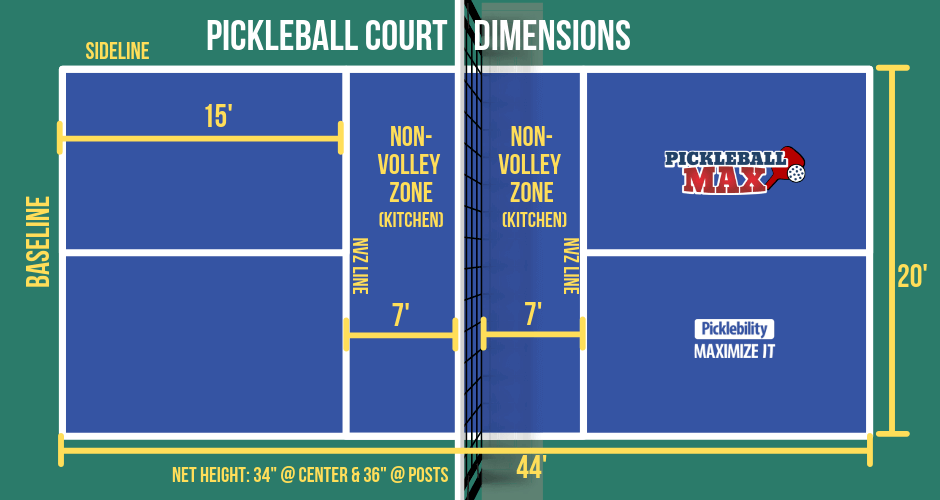
A pickleball court is 20 feet by 44 feet, with a 34-inch center net.
If you want the full story behind pickleball court size, you’re in the right place. I’ve built, marked, and played on dozens of courts, from driveways to clubs. In this guide, I’ll break down every line, zone, and clearance so you can build or judge a court with confidence. Let’s make pickleball court size simple and accurate.
Official pickleball court size explained
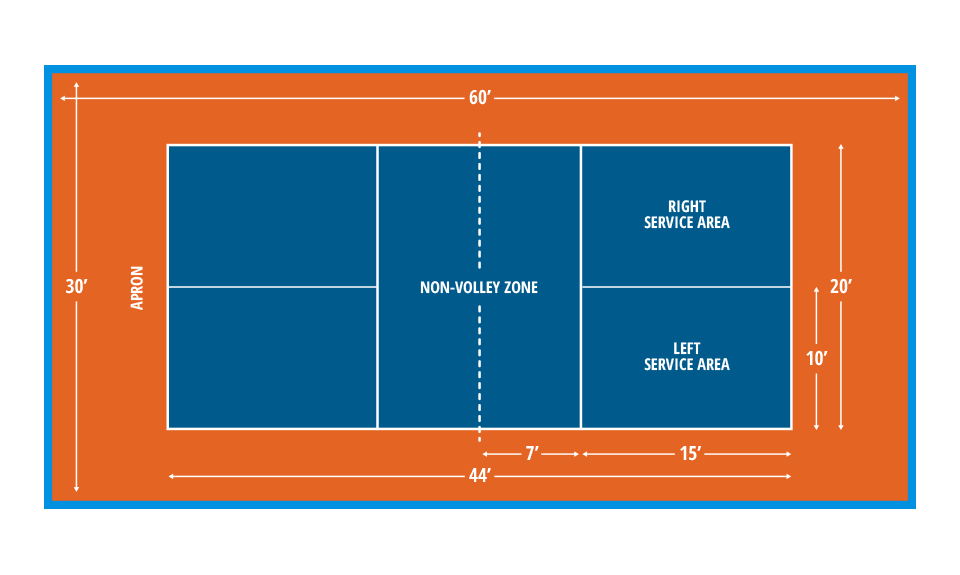
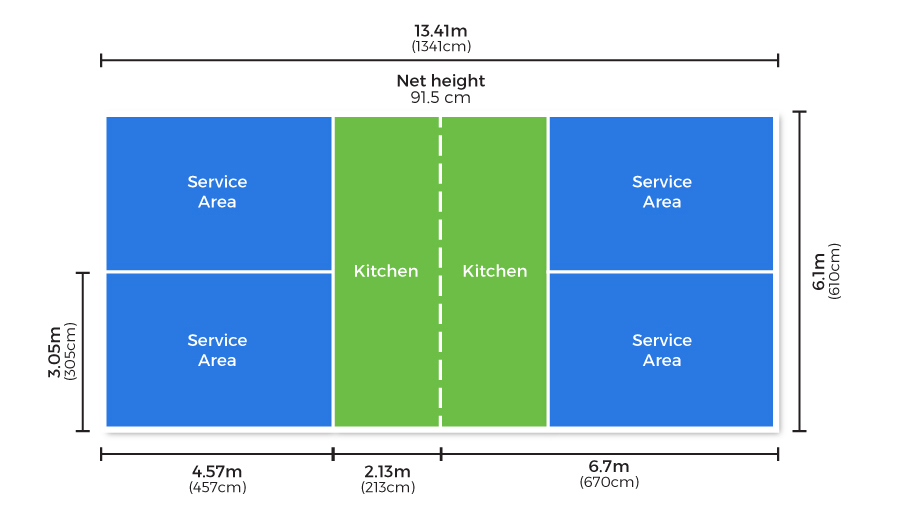
The standard pickleball court size is 20 feet wide by 44 feet long. Singles and doubles use the same court. That is part of the charm of the game. Lines are part of the court, so include them in the size.
The net is 36 inches high at the sidelines. It is 34 inches at the center. Posts sit about 22 feet apart. A typical portable net spans 22 feet to reach each post.
Line width is 2 inches. Keep that the same across the court. That helps calls and safety. This is the same in indoor and outdoor play.
Why does pickleball court size matter? It sets fair play. It guides safe run‑off space. It also helps when you convert a tennis court.
Court layout and zones
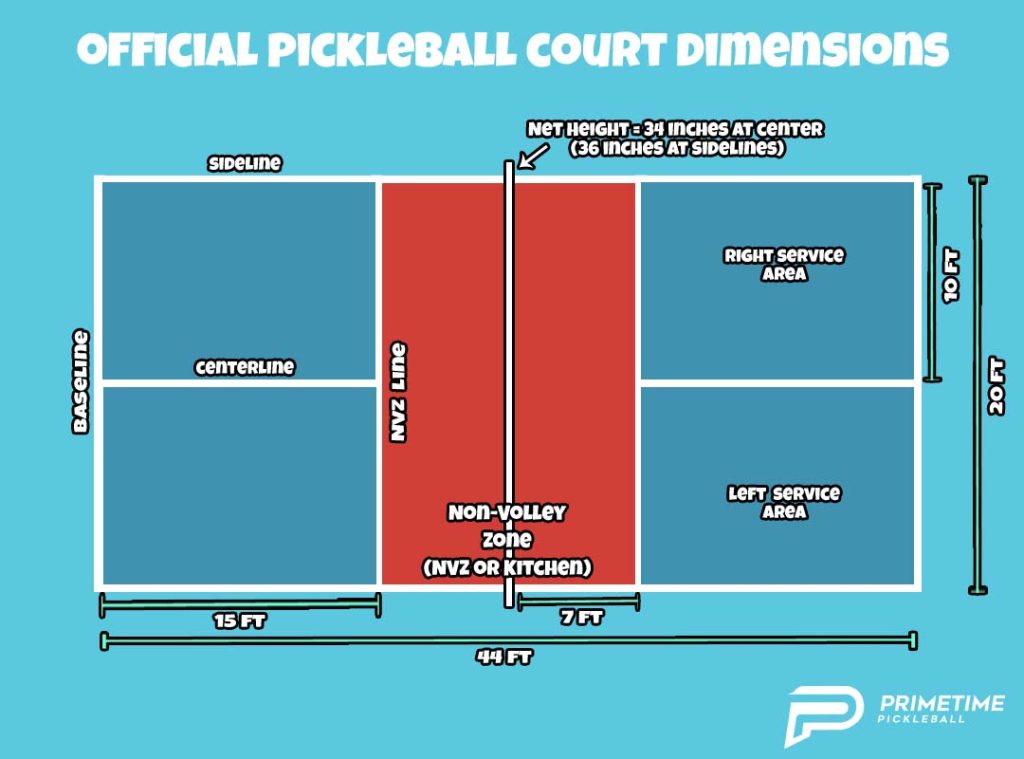
Pickleball court size is not just the box. The zones shape the game. Each zone has a job, and each line has a rule. Here is how it breaks down.
Baselines and sidelines
The baseline runs the 20-foot width at each end. You serve from behind it. The sideline runs the 44-foot length on each side. The lines are in.
Non-volley zone
The non-volley zone is the kitchen. It is 7 feet from the net on both sides. You cannot volley while in it. The NVZ line is part of the zone.
Service courts and centerline
Each side has two service boxes. Each box is 10 feet by 15 feet. A centerline splits them. The service must land cross-court, past the NVZ line.
Net and posts
The net drops to 34 inches at center. Check that sag with a tape. The posts hold 36 inches at the sides. Tension should be firm, but not too tight.
When you mark these zones right, pickleball court size comes to life. Small errors can change play. A one-inch drift on the NVZ line can cause debates.

Space around the court and run-off
A true court needs more than the 20 by 44 box. You need space to move. The minimum playing area is 30 feet by 60 feet. The preferred space is 34 feet by 64 feet. Many clubs use the larger size for events.
Plan for at least 5 feet clear on the sides. Plan 8 to 10 feet behind each baseline. That keeps feet safe on hard runs. It also reduces fence crashes.
For indoor play, aim for 20 feet of clear ceiling height. Lights should be bright and even. For outdoor courts, keep fences or walls back if you can. Good run‑off beats fancy windscreens every time.
These clearances are part of smart pickleball court size planning. They protect players and keep rallies fun.
Indoor vs outdoor considerations
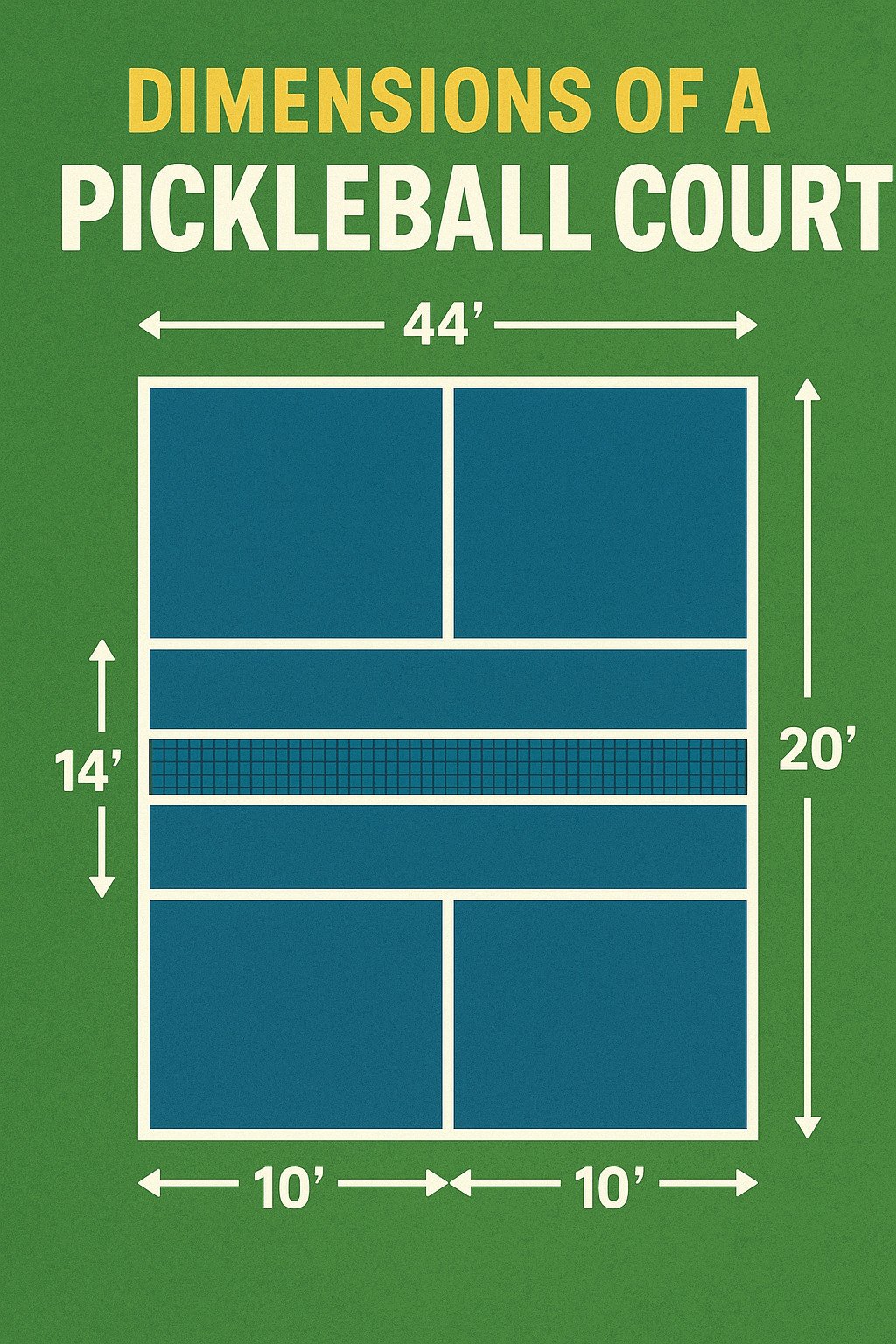
Pickleball court size stays the same indoors and outdoors. But the surface and space feel different. Plan with that in mind.
- Surface choice matters. Acrylic hard courts give a true bounce. Sport tiles are fast to install and gentle on joints.
- Lighting needs to be even. Aim for soft, bright light. Avoid glare spots at the kitchen.
- Wind and sun shape outdoor games. If you pour a court, set it north–south. That cuts glare at sunrise and sunset.
- Drainage saves courts. A small slope, about 1 percent, moves water off. Keep puddles off the kitchen.
- Color helps tracking. Use a lighter kitchen, darker service boxes, and white 2-inch lines.
I have seen great games on a taped gym floor. I have also seen bad games on a slick patio. Think beyond pickleball court size, and plan the feel of the space.

Converting a tennis court or driveway
A tennis court can host four pickleball courts. This is a popular way to grow the sport. It starts with correct pickleball court size and smart spacing.
- On one tennis court, set two courts per side of the net. Turn them crosswise to the tennis net.
- Keep 8 to 10 feet between back-to-back baselines if possible.
- Leave 5 to 7 feet between side-by-side sidelines.
- Use portable pickleball nets at 22 feet wide. Do not try to use a sagging tennis net.
- Choose high-contrast tape or paint for lines. Use 2-inch width for clarity.
On driveways, space is tight. Mark a 16 by 36 mini-court for practice if you must. Still use the right kitchen depth at 7 feet. You will feel the game flow even at that scale.
Pickleball court size guides the layout, but smart spacing makes it playable and safe.
Building or marking your own pickleball court size: tools and steps
You can DIY a court in a day with the right plan. Keep it simple and measure twice. Here is a field-tested workflow I use.
Tools
- 100-foot tape measure
- Two tape measures or a helper
- Chalk line or string line
- Painter’s tape, court tape, or striping paint
- Square, stakes, and a pencil
- Net with center strap and a net gauge
Steps
- Set your rectangle. Mark a 20 by 44-foot box. Check diagonals are equal to ensure it is square.
- Place the net. Mark the center line across the 20-foot width. Set posts so the net edge sits on that line.
- Add the kitchen. Measure 7 feet from the net on both sides. Snap a chalk line and mark the NVZ line.
- Split service boxes. Find the court’s long center. Snap a centerline from the baseline to the NVZ line. That creates two 10 by 15 service boxes.
- Tape or paint lines. Keep all lines 2 inches wide. Use a steady hand at corners.
- Set net height. 36 inches at each sideline and 34 at center. Use the center strap to dial it in.
- Walk the court. Check for tripping points. Press tape edges and fix smears at once.
Do not rush steps one and six. Most play issues come from a crooked box or a loose net. A clean layout locks in the true pickleball court size.

Common mistakes and pro tips from the court
I have made these mistakes so you do not have to. Each one can make a match less safe or less fair.
Mistakes to avoid
- Short run‑off. If players fear the fence, they play tight and tense.
- Wrong net height. A loose net steals rallies at the kitchen.
- Crooked centerline. Serves look good until close calls spark debate.
- Slippery paint. High-gloss paint is slick. Use court-grade coatings.
- Skipping re-measure. Heat and tape stretch. Recheck after the first game.
Pro tips
- Mark center dots on each baseline. They speed up fair serves.
- Use contrasting colors for the kitchen and service boxes.
- Add small arrows at the NVZ corners. New players learn faster.
- Keep a spare center strap and net gauge in your kit.
- Take photos of your layout. Note fixes for next time.
These simple habits keep your pickleball court size true and your games smooth.

Accessibility, safety, and maintenance
The best courts welcome everyone. Plan for safety, comfort, and care. It starts with more than just pickleball court size.
- Keep clear walkways at least 36 inches wide around courts.
- Use edge padding near fences or posts.
- Post basic rules and net height. Quick reminders help new players.
- Sweep or blow debris daily. Grit and leaves cause slips.
- Wash surface stains fast. Oil spots turn slick in heat.
- Check tape edges and net tension each week.
A safe court brings people back. Good care protects the surface and the true pickleball court size over time.
Frequently Asked Questions
What is the official pickleball court size?
It is 20 feet by 44 feet for singles and doubles. Lines are 2 inches and count as in.
How high is a pickleball net?
It is 36 inches at the sidelines and 34 inches at center. Use a center strap to set the sag.
How much space do I need around the court?
Aim for 30 by 60 feet at minimum. If you can, build 34 by 64 feet for better safety.
Can I fit four courts on one tennis court?
Yes, four courts fit with portable nets and clear spacing. Keep 5 to 7 feet side gaps and 8 to 10 feet behind baselines if possible.
What is the size of the non-volley zone?
It is 7 feet from the net on each side. The NVZ line is part of the zone.
Do singles use a different pickleball court size?
No, singles and doubles share the same size. Strategy changes, but the court stays 20 by 44 feet.
What width should the lines be?
Use 2-inch-wide lines across the whole court. Consistent width helps clear calls and safe footing.
Conclusion
Now you know the full picture behind pickleball court size. From the 20 by 44 box to the run‑off, net height, and lines, each detail shapes fair play and safety. Use this guide to mark a court, convert a space, or check your club’s layout.
Grab a tape, set your lines, and bring your court to life. If this helped, share it with your pickleball group, subscribe for more build guides, or drop your court questions in the comments.