A single outdoor pickleball court costs about $30,000–$110,000, all-in.
If you want the full story on pickleball court cost, you’re in the right place. I’ve helped homeowners, HOAs, and city parks bid, build, and maintain courts. In this guide, I’ll break down every line item, share real numbers, and give tips to save money without cutting quality. By the end, you’ll know what to expect, what to avoid, and how to budget with confidence.

What drives pickleball court cost
Many items shape the final price. Some are obvious, like the slab and paint. Others hide in the dirt, like drainage and soil work. The biggest cost drivers are:
- Site conditions Good access, flat land, and stable soil cut costs fast. Clearing, grading, and tree removal raise costs.
- Base type Asphalt is cheaper up front. Post-tension concrete costs more but lasts longer and cracks less.
- Surfacing system Acrylic color coats are the standard outdoors. Modular sport tiles cost more but install fast and drain well.
- Fencing and gates Taller fences, divider fencing, and wind screens add cost but improve play.
- Lighting Night play means poles, LEDs, and wiring. This is a big ticket item.
- Labor and location Labor rates and material delivery drive regional price swings.
- Permits, design, and drainage Skipping these steps often leads to costly fixes later.
- Extras Benches, shade, storage, water access, and branding add comfort and cost.
From experience, the base and lighting are the two largest line items on most builds. Plan those first, then fit the rest to your budget.
Typical cost ranges at a glance
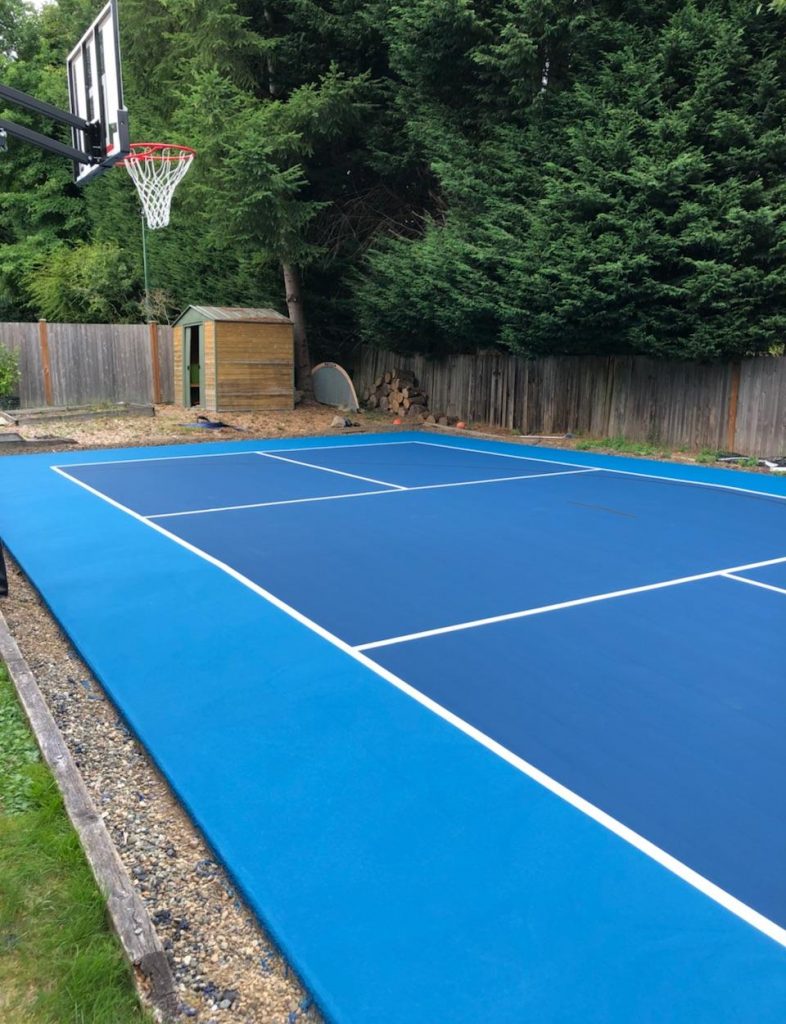
Here are realistic ranges for a single court with standard clear zones of about 30 by 60 feet.
-
Budget backyard on existing slab
- Restriping and minimal net system
- $2,000–$7,500 if slab is sound
-
New outdoor asphalt court
- Grading, compacted base, 3–4 inch asphalt, acrylic surfacing, lines, basic fencing
- $30,000–$70,000
-
New outdoor post-tension concrete court
- Long-life slab, acrylic surfacing, lines, mid-grade fencing
- $55,000–$110,000
-
Add LED lighting to a single court
- Four poles, quality LED heads, wiring, trenching
- Add $15,000–$40,000
-
Convert one tennis court to pickleball
- Restriping and portable nets for 2–4 courts
- $2,000–$15,000
- With resurfacing, divider fences, and fixed posts
- $25,000–$60,000
-
Indoor pickleball court cost
- In an existing building with sport tile, lighting, and lines
- $25,000–$90,000 per court area
- New metal building shell, slab, HVAC, lighting, floor
- $150,000–$500,000+ for one court bay, depending on size and code
Use these as planning ranges. Your final pickleball court cost will reflect soil, access, and finish choices.

Detailed cost breakdown
Site work and drainage
- Clearing, grading, and base prep $5,000–$25,000
- Drainage (swales, French drains, catch basins) $3,000–$20,000
- Access paths, staging, spoil removal $1,000–$8,000
Tip Keep water away from the slab. Good drainage lowers long-term pickleball court cost.
Base and slab
- Asphalt base with compacted stone $6–$12 per square foot
- Post-tension concrete slab $12–$22 per square foot
- Soil stabilization if needed $2–$6 per square foot
For a 30 by 60 foot court area (1,800 square feet), that is:
- Asphalt base $10,800–$21,600
- Post-tension concrete $21,600–$39,600
Surfacing and striping
- Acrylic color system (2–3 coats) $1.50–$2.50 per square foot
- Cushion layers (optional) Add $1.50–$3.00 per square foot
- Lines and logos $300–$1,200
Fencing and gates
- 10-foot chain-link with gates $25–$45 per linear foot
- For a typical 120–160 linear feet run $3,000–$7,200
- Divider fences and wind screens Add $1,000–$4,000
Net posts and nets
- Permanent post set with sleeves $400–$1,200
- Regulation net $200–$400
- Portable net systems $200–$500 each
Lighting
- Poles, LED fixtures, trenching, wiring $15,000–$40,000 for one court
- Controls and smart timers Add $500–$2,000
Amenities
- Benches and shade $500–$5,000
- Storage locker or shed $500–$3,000
- Water fountain or bottle fill $1,500–$6,000
Soft costs
- Design and layout $1,000–$5,000
- Permits and inspections $500–$3,000
- Testing and survey $500–$2,500
- Insurance and bonds (for public jobs) 1–3 percent of contract
Labor and overhead
- Often 30–50 percent of total build cost
- Higher for complex sites or tight access
Plan a 10–15 percent contingency. Surprise rock, utilities, or weather can add days and dollars.
Build scenarios and sample budgets
Scenario 1 Budget backyard, asphalt base, no lights
- Grading and base $8,000
- Asphalt slab $15,000
- Acrylic surfacing and lines $3,600
- Fencing on two sides only $2,500
- Net posts and net $800
- Permits and misc $1,100
- Total $31,000
Scenario 2 HOA showpiece, post-tension, full fence, lights
- Site work and drainage $18,000
- Post-tension slab $32,000
- Acrylic surfacing with cushion $7,200
- Full 10-foot fence and wind screens $6,500
- Four-pole LED lights $28,000
- Benches and shade $3,000
- Soft costs and contingency $8,000
- Total $102,700
Scenario 3 Tennis conversion to two courts, mid-upgrade
- Crack repair and resurfacing $12,000
- Restriping for two courts $1,000
- Permanent posts and two nets $2,000
- Divider fence and gates $6,000
- Windscreens $1,500
- Total $22,500
These are real-world mixes I see often. Your pickleball court cost may vary, but these models help frame bids.

New build vs conversion Which is cheaper
Converting an existing tennis court is usually the fastest path. If the base is sound, you can repaint and add nets for a low cost. Expect $2,000–$15,000. Add more if you need divider fences, new sleeves, or resurfacing.
A new build gives you perfect layout, drains, and warranties. It costs more but can save on future fixes. For public parks with heavy use, I lean new build with post-tension concrete. It keeps the long-term pickleball court cost lower by fighting cracks.
Indoor vs outdoor pickleball court cost
Outdoor courts win on price. They need a slab, paint, fence, and maybe lights. Indoor courts add a shell, insulation, HVAC, and life safety systems.
-
Using an existing gym or warehouse
- Sport tile or acrylic over slab $3–$7 per square foot
- LED high-bays and controls $5,000–$20,000 per court area
- Striping and nets $500–$2,000
-
New indoor building
- Pre-engineered metal building $70–$150 per square foot, size dependent
- Slab and finish floor $10–$25 per square foot
- HVAC, electrical, and code items vary by climate
Indoor makes sense for year-round play and revenue. But the indoor pickleball court cost can be many times an outdoor build.

Regional price differences and timeline
Labor and freight push prices up in some areas. Urban coasts and remote regions tend to be higher. The Midwest and South often come in lower.
- Regional premium or discount plus or minus 10–25 percent
- Lead times for lights and fencing 4–12 weeks
- Build time for one court 3–6 weeks once materials are on site
- Best seasons for outdoor work spring and fall in most climates
Plan early. Lock your contractor and long-lead items to control your pickleball court cost.

Maintenance and lifecycle costs
A good court is not set-and-forget. Budget a small yearly spend to protect the big investment.
- Annual cleaning and minor repairs $300–$1,200
- Acrylic resurfacing every 4–7 years $4,000–$9,000
- Crack repairs as needed $500–$3,000
- Net replacement every 3–5 years $200–$400
- LED energy cost is low, but plan $300–$900 per year if you run nights often
Post-tension concrete has a higher up-front pickleball court cost but lower crack repairs over time. It is a smart pick for heavy use.

Money-saving tips without cutting corners
- Choose the right site Flat, well-drained ground saves thousands.
- Convert smart If the tennis base is sound, restripe and add portable nets first.
- Phase upgrades Start with the slab and surfacing. Add lights and windscreens later.
- Use standard colors Specialty pigments and logos add cost with no play gain.
- Share access Add one set of lights between two side-by-side courts.
- Buy in bulk For HOAs, order nets, windscreens, and benches together.
- Get three bids Make sure the scope matches line by line.
Every cut should be cost-smart, not quality-blind. Safety, drainage, and the slab are not places to trim.
Common mistakes to avoid
- Skipping soil and drainage checks Water wins every time if you ignore it.
- Under-sizing the play area You need about 30 by 60 feet per court, not just 20 by 44.
- Painting too soon Let asphalt cure and outgas. Rushing leads to bubbles and peels.
- Buying weak lights Cheap fixtures cause glare and dark corners.
- No warranty clarity Get slab, surfacing, and light warranties in writing.
These errors raise your pickleball court cost later. Slow down at the start to move fast at the end.
How to budget and compare contractor bids
Ask each bidder for the same scope. When line items match, you can compare apples to apples.
-
Must-have lines
- Site prep, base thickness, and reinforcement
- Drainage plan and materials
- Surfacing system and number of coats
- Fence height, mesh, gates, and hardware
- Lighting brand, pole count, and foot-candle targets
- Warranty terms for slab and surface
- Schedule and payment milestones
-
Red flags
- Vague “allowances” for key items
- No soil or compaction testing
- Missing drainage or cure times
In my bids, I add a one-page map with layout, runouts, and pole spots. This reduces change orders and keeps your pickleball court cost on track.
Quick calculator Estimate your pickleball court cost
Use this simple method to set a starting budget.
-
Pick a base type
- Asphalt Use $10 per square foot for slab + base
- Post-tension Use $17 per square foot for slab + base
-
Add surfacing and lines
- Use $2 per square foot for standard acrylic
-
Add fence
- Use $35 per linear foot, about 140 feet typical
-
Add lights if needed
- Use $25,000 for a single court package
-
Do the math for a 30 by 60 foot area (1,800 square feet)
- Asphalt slab $18,000
- Acrylic $3,600
- Fence $4,900
- Lights $25,000
- Base site work and soft costs (estimate) $10,000
- Total $61,500
Adjust for your site and region. This puts your pickleball court cost in the right range fast.
ROI for clubs, HOAs, and cities
Courts can pay back when programmed well.
- Revenue ideas
- Court rentals $10–$40 per hour
- Clinics and leagues $15–$30 per player per session
- Sponsorship signs on fences
One busy court can book 30–50 hours per week in-season. At $20 per hour, that is $600–$1,000 weekly. Even after lights and care, payback on a $60,000 build can land in a few years. This is why many groups see a strong case for their pickleball court cost.
Frequently Asked Questions of pickleball court cost
How much does it cost to build one pickleball court?
A typical outdoor court costs $30,000–$110,000, depending on base, fence, and lights. Backyard conversions can be far less if you reuse a slab.
What is cheaper, asphalt or concrete for courts?
Asphalt is cheaper up front. Post-tension concrete costs more but resists cracks and can be cheaper over the court’s life.
How big should a pickleball court area be?
The play lines are 20 by 44 feet. Plan about 30 by 60 feet with clear zones for safe play.
What does indoor pickleball court cost include?
For indoor, add the building shell, HVAC, lighting, and a sport floor. If you already have a gym, you may only need tile, lights, and lines.
How often do I need to resurface?
Most acrylic courts need resurfacing every 4–7 years. High-use or harsh climates may need it sooner.
Can I put a court on my driveway?
Yes, if the slab is sound and fairly level. Lines and a portable net can create a low-cost setup.
Are lights worth the cost?
If you want prime-time play, yes. LED lights add $15,000–$40,000 but can double usable hours.
Conclusion
Now you know what shapes pickleball court cost, from the dirt under your feet to the lights above your head. Start with a clear site plan, pick the right base, and phase the extras. That simple path protects your budget and your play.
Ready to plan your court? Use the calculator, jot down your must-haves, and request three matching bids. If this guide helped, share it with your team, subscribe for more build tips, or leave a question so I can help you dial in your numbers.