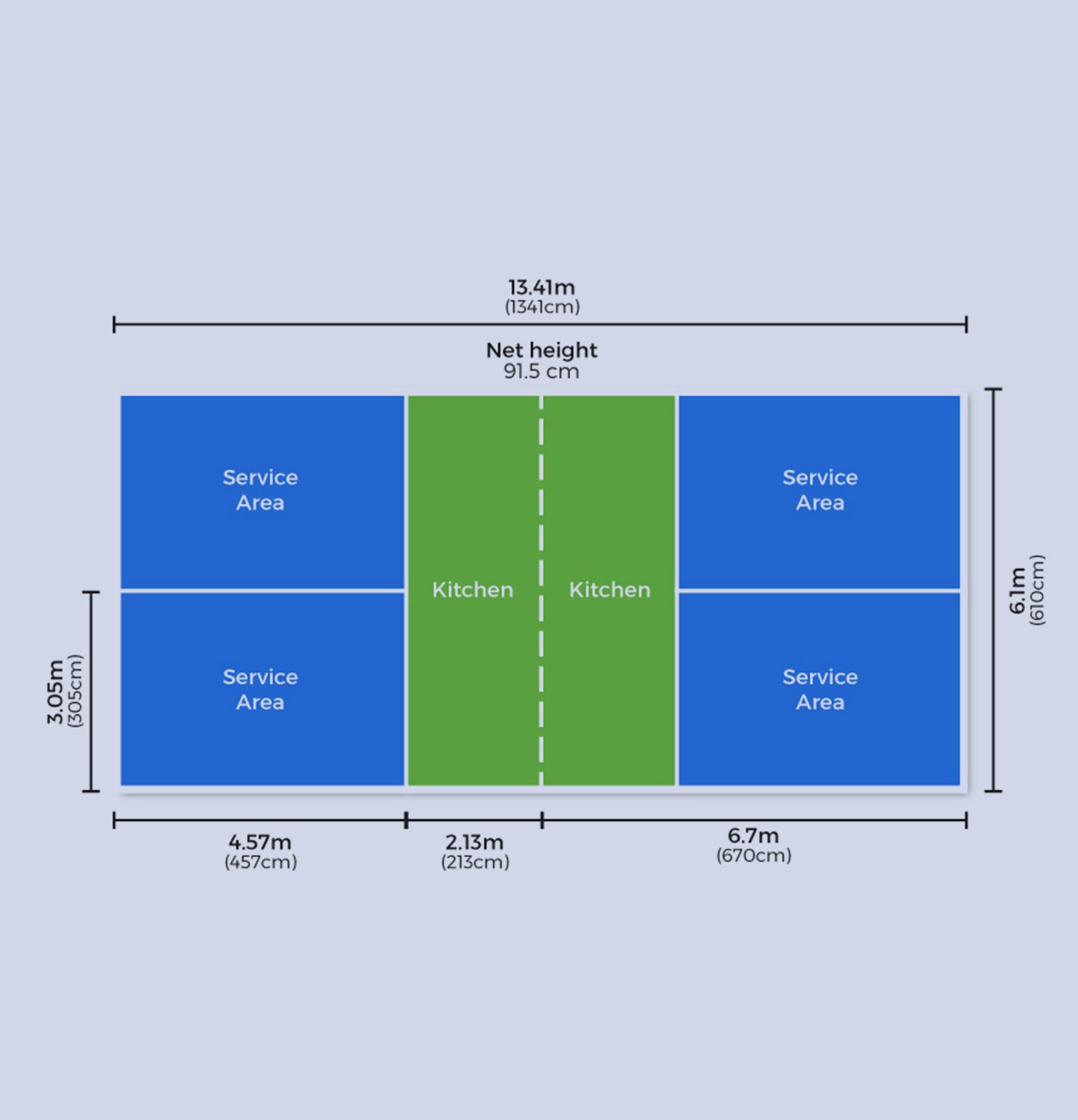
Standard pickleball court size is 20 feet by 44 feet, singles and doubles.
If you want reliable, competitive play, you need the court to be exact. I’ve lined courts for parks, gyms, and noisy driveways, and small errors can ruin rallies fast. In this guide, I’ll break down the standard pickleball court size in plain language, share pro tips from the field, and show you how to plan, measure, and build a court that plays true from day one.
The official standard pickleball court size and key numbers
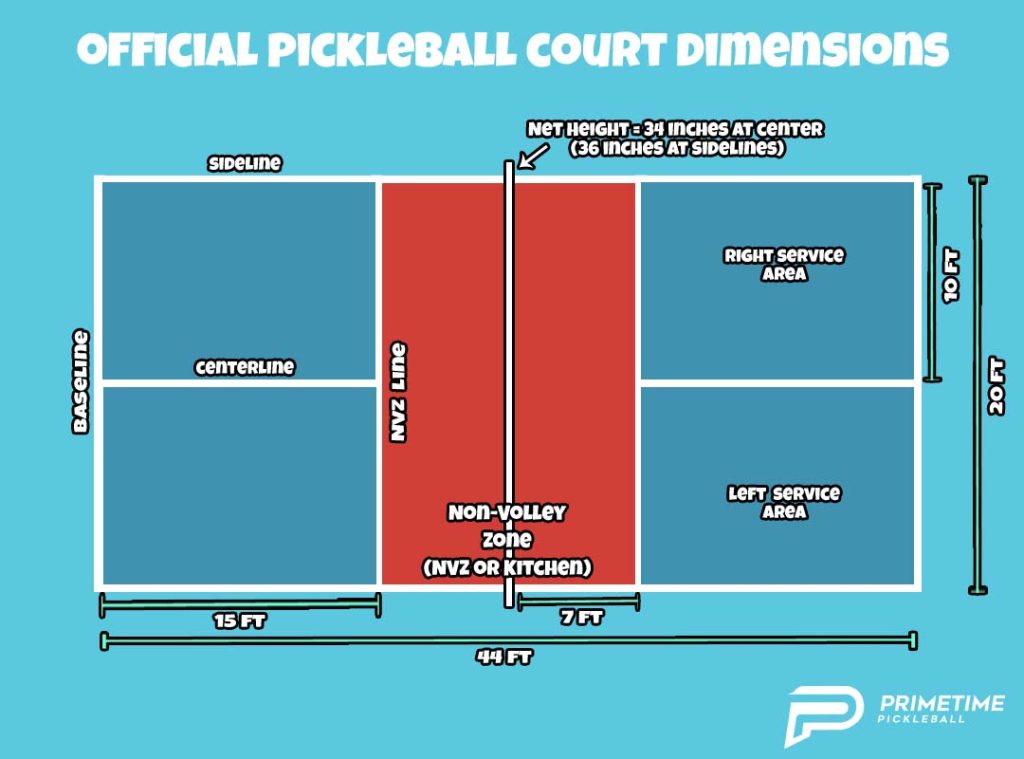
The standard pickleball court size follows one global spec used in leagues and tournaments. These are the numbers you must hit.
- Court dimensions: 20 feet wide by 44 feet long. This is the same for singles and doubles.
- Net height: 36 inches at the sidelines and 34 inches at the center.
- Non-volley zone: 7 feet from the net on each side.
- Service area length: 15 feet from the non-volley line to the baseline.
- Service courts: Each side is split into right and left boxes by a centerline. Each box is 10 feet by 15 feet.
- Line width: 2 inches. Lines are part of the court.
- Net post spacing: 22 feet between inside faces of the posts. The net length is 21 feet 9 inches to allow proper tension.
Pro tip from the job site: Always recheck the net height after tensioning. It often drops a half inch in the center if you set corner height first.
If you follow these specs, you are using the standard pickleball court size recognized in official rulebooks and by local clubs.
Court layout explained: zones and lines
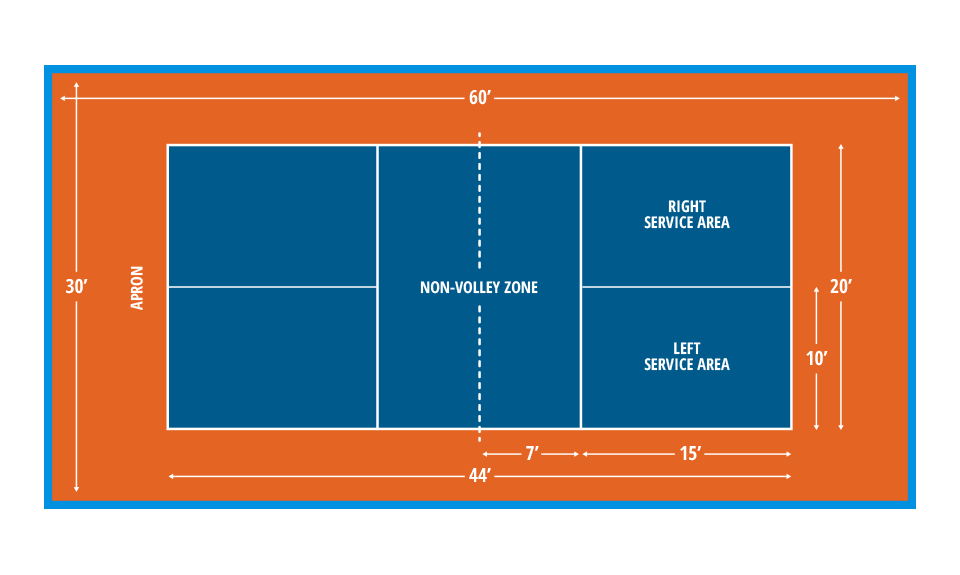
A clean layout keeps play fair and fast. Here is how the standard pickleball court size breaks down on the ground.
- Baselines: The back lines. Serves must land past the non-volley line and inside the sidelines.
- Sidelines: The side edges. Shots landing on the line are in.
- Non-volley zone line: Drawn 7 feet from the net on both sides. You cannot volley while standing in this zone.
- Centerline: Runs from the non-volley line to the baseline. It splits the service area into right and left rectangles.
- Service boxes: Two per side. You serve cross-court into the opposite box.
When I teach new players, I tell them to see the court like a grid: a 20-by-44 frame with a 7-foot “no-fly” strip by the net, and two 10-by-15 target zones behind it. This mental map helps with serve aim and third-shot drops.

Total playing area and space planning
The court is 20 by 44, but you need space around it for safe movement. This is where many home builds go wrong.
- Minimum recommended playing area: 30 feet by 60 feet.
- Preferred event space: 34 feet by 64 feet for more run-off.
- Indoor ceiling clearance: 18 to 20 feet is ideal to avoid lobs hitting lights or beams.
- Best orientation outdoors: North–south to reduce sun glare.
If you plan a community build, use the preferred 34 by 64 footprint. It reduces collisions with fences and keeps rallies clean. It still uses the same standard pickleball court size in the middle.

Indoor vs outdoor builds and surfaces
The standard pickleball court size stays the same indoors and outdoors, but surfaces and ball types change the feel.
- Outdoor surfaces: Post-tension concrete or asphalt with acrylic coatings. Durable, grippy, and weather-ready.
- Indoor surfaces: Wood gym floors or sport tiles. Faster bounce, softer on joints.
- Ball choice: Outdoor balls have more, smaller holes and feel firmer. Indoor balls have fewer, larger holes and feel softer.
- Slope and drainage outdoors: Aim for about 1 percent slope away from the court center for runoff.
- Color contrast: Use a light line color, often white, against a darker court color for visibility.
In my experience, outdoor acrylic with a cushioned layer is the sweet spot for long play. It protects knees without getting sticky in the heat.

Step-by-step: How to mark and measure a court
You can DIY a temporary court in a driveway or gym, or lay out a permanent surface. The standard pickleball court size process is simple if you measure twice.
- Tools you need: 100-foot tape measure, chalk line or painter’s tape, square, stakes, string, and a level net system.
- Create the 20-by-44 rectangle: Mark corners and snap chalk lines for baselines and sidelines.
- Check the diagonal: Corner to corner should be about 48 feet 4 inches. Matching diagonals means your rectangle is square.
- Mark the non-volley zone: Measure 7 feet from the net line on both sides and snap lines across.
- Add the centerlines: From the non-volley line to the baseline on each side, centered at 10 feet from each sideline.
- Apply lines at 2 inches wide: Keep edges crisp. Lines are in.
- Set the net: Posts at 22 feet apart inside face. Net at 36 inches at the sides and 34 inches at center.
Quick field tip: If your diagonals are off, adjust only one corner at a time. Nudge it by a few inches, remeasure, and repeat until both diagonals match. This locks in the standard pickleball court size with precision.

Converting a tennis court, driveway, or gym
You can fit a regulation court in many spaces if you plan well.
- On a tennis court: One 60-by-120 tennis court can hold up to four pickleball courts with proper spacing. Use portable nets or shared lines. Mind neighbors for noise.
- Driveway or parking lot: If you can carve out 30 by 60 feet, you can host a safe court. Use removable tape or chalk to protect surfaces.
- School gyms: The standard pickleball court size fits easily on basketball floors. Use painter’s tape or temporary lines if permanent paint is not allowed.
What I’ve learned: Share your layout plan with facility managers early. Show the 20-by-44 footprint and the 30-by-60 clear space. It speeds approvals and avoids surprises.

Common mistakes, pro tips, and safety
Little errors can turn into big headaches. Here is what to watch.
- Mistake: Short non-volley zone. Fix by remeasuring 7 feet from the net cord, not from the post.
- Mistake: Net sagging below 34 inches at center. Use a center strap or reset tension after 10 minutes.
- Mistake: Lines too narrow or too wide. Stick to 2 inches to match the standard pickleball court size.
- Mistake: Poor sun orientation. Courts facing east–west blind players during morning or evening play.
- Mistake: Slippery paint or dusty gym floors. Use textured coatings or clean before play.
Safety basics I recommend:
- Clear 3 feet of space around the court lines at minimum.
- Use rounded, padded posts if possible.
- Keep balls, bags, and chairs outside the run-off area.
Cost, materials, and maintenance
Budget varies by surface and location, but planning ahead saves money.
- Temporary setup: Painter’s tape, a portable net, and a measuring tape. Good for driveways and gyms.
- Semi-permanent: Roll-on acrylic over asphalt or concrete with painted lines.
- Permanent build: Post-tension concrete slab, acrylic cushioned system, fencing, windscreens, and lighting.
Maintenance checklist:
- Sweep or blow off debris before play.
- Repaint lines when they fade to keep the standard pickleball court size crisp.
- Check net height weekly and replace frayed cords.
- Inspect for cracks and seal early to prevent water damage.
From experience, bright lines and a properly set net do more for play quality than any fancy accessory. Keep those perfect and your court will feel pro.
Frequently Asked Questions of standard pickleball court size
Is the standard pickleball court size the same for singles and doubles?
Yes. Singles and doubles both use 20 feet by 44 feet. The game scales by players, not by court size.
How wide are the lines on a pickleball court?
Lines are 2 inches wide and count as in. Keep widths consistent across the whole court.
What is the non-volley zone distance from the net?
It is 7 feet from the net line on both sides. Players cannot volley while touching this zone.
How high should the net be in the center?
Set the net to 34 inches at the center and 36 inches at the sidelines. Recheck after tensioning.
What is the recommended total area around the court?
Aim for at least 30 by 60 feet, with 34 by 64 preferred. This gives safe run-off and better play.
Can four pickleball courts fit on one tennis court?
Yes, many facilities fit four courts within a standard 60 by 120 tennis court. Use proper spacing, lines, and portable nets.
What is the diagonal length of a regulation pickleball court?
About 48 feet 4 inches from corner to corner. Matching diagonals confirm the rectangle is square.
Conclusion
The standard pickleball court size is simple, but precision matters. Stick to 20 by 44 feet, set the net to 36 at the sides and 34 at center, and protect 30 by 60 feet of total space. These basics create fair bounces, safer movement, and better rallies.
If you are planning a home build or a park upgrade, start with a tape measure and a clear layout. Take your time, check the diagonals, and lock in clean lines. Ready to go deeper? Explore more how-tos, ask a question in the comments, or subscribe for step-by-step build guides and gear picks.