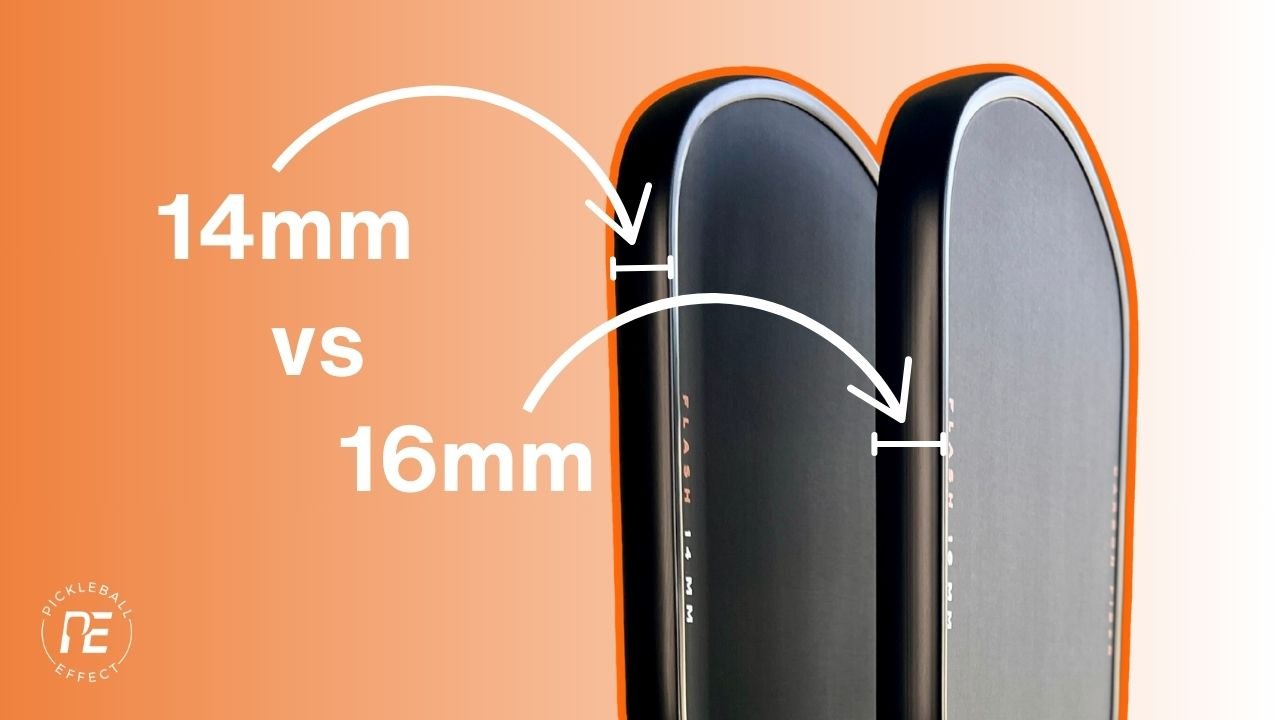
14 mm paddles give more pop; 16 mm paddles offer better control and stability.
If you are stuck on 14 mm vs 16 mm pickleball paddle, you are not alone. I test paddles weekly with players from rec to tournament level, and thickness is the most misunderstood spec. In this guide, I break down how thickness changes power, touch, spin, feel, noise, and even arm health. You will see when to choose 14 mm vs 16 mm pickleball paddle, how to test both, and how to tune your setup for your game.
What paddle thickness actually does
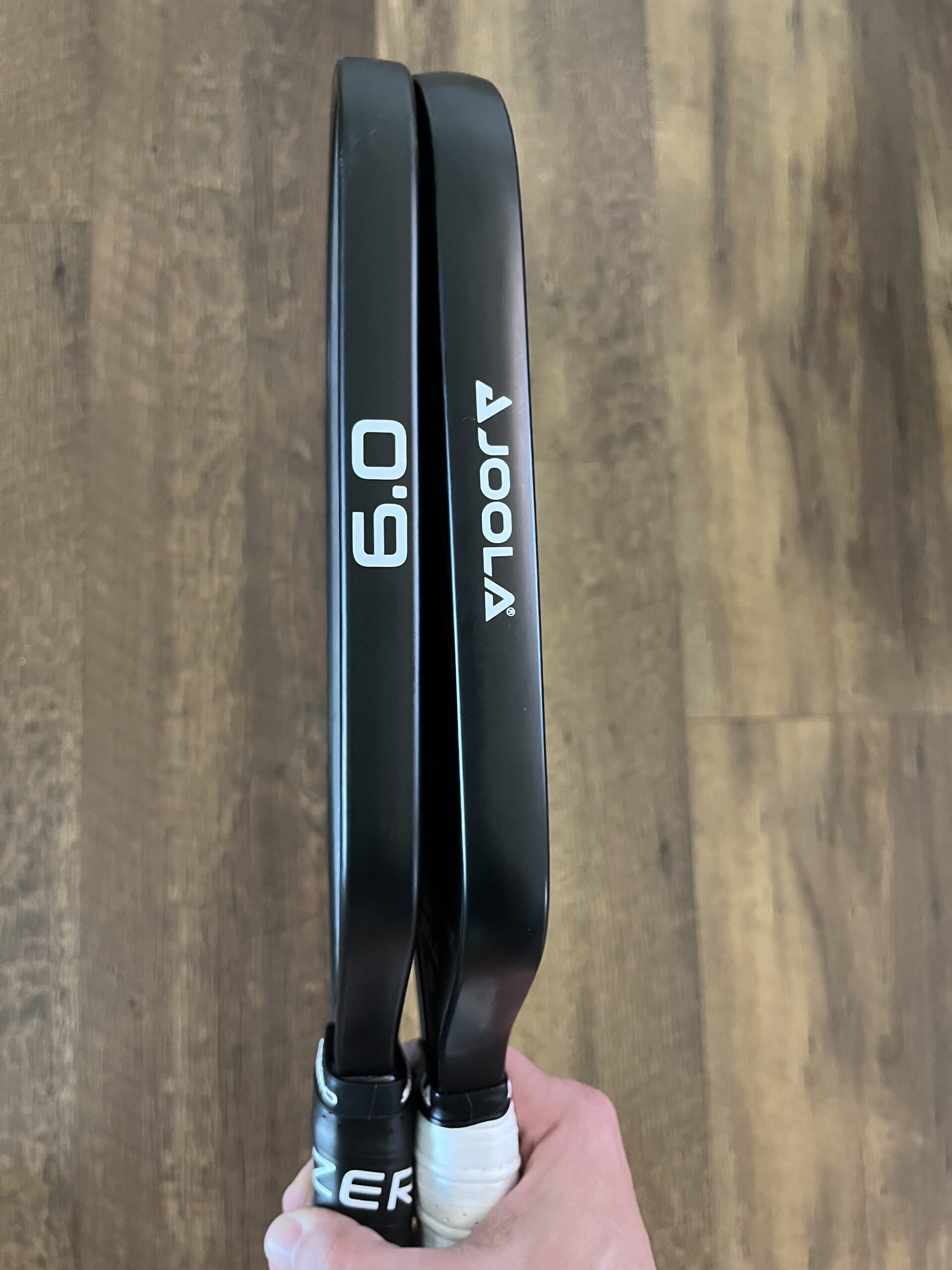
Thickness changes how long the ball stays on the face, how much the face flexes, and how vibration moves through your hand. A thinner core, like 14 mm, flexes less and returns energy faster. That quick rebound gives easy pop on volleys and drives. A thicker core, like 16 mm, adds dwell time for control and a softer feel on resets.
In simple terms, thickness is a power-control lever. Other specs still matter a lot. Weight, swing weight, twist weight, face material, and core design can change the feel more than thickness alone. But when two paddles share the same build, thickness becomes the tie-breaker.
14 mm vs 16 mm pickleball paddle: the key differences
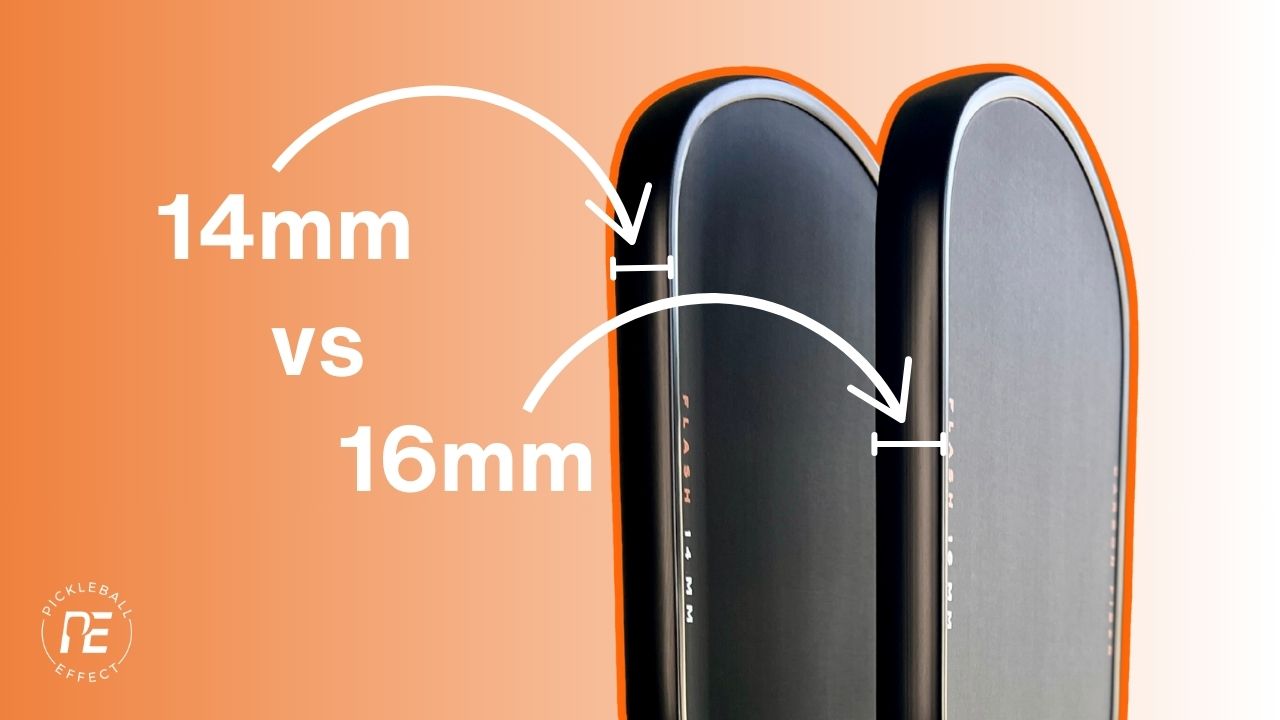
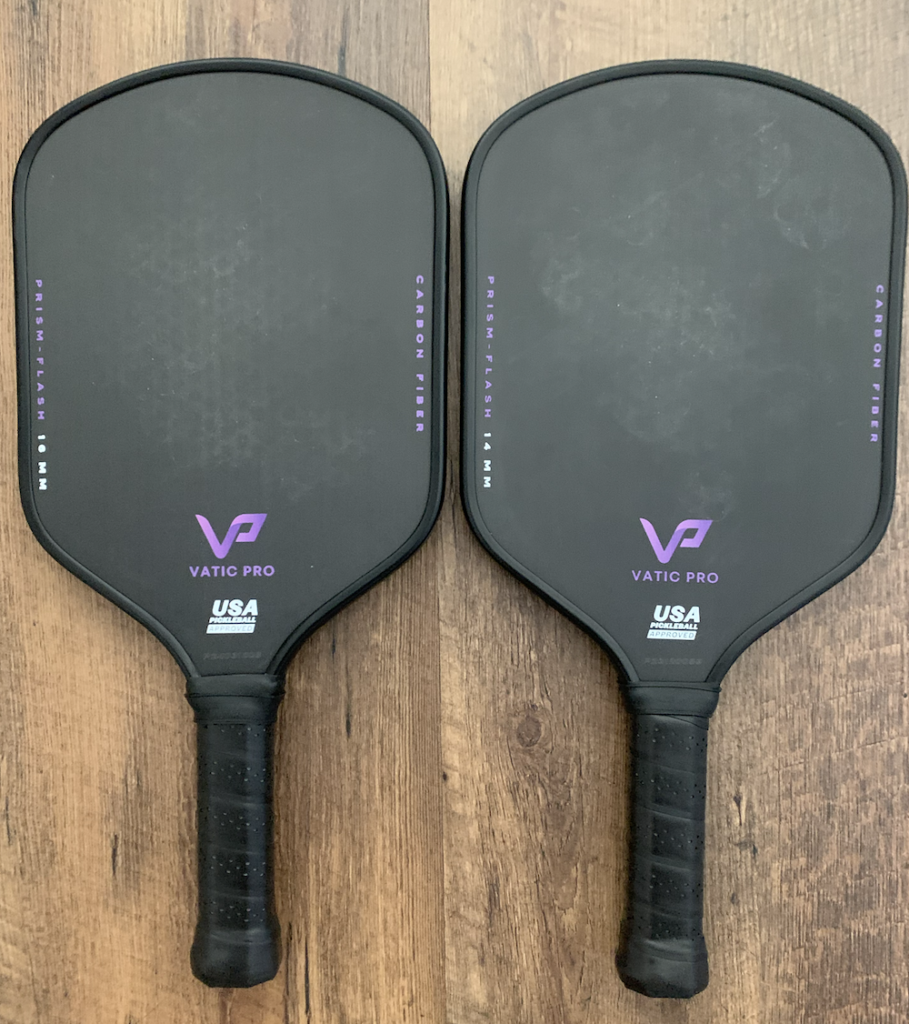
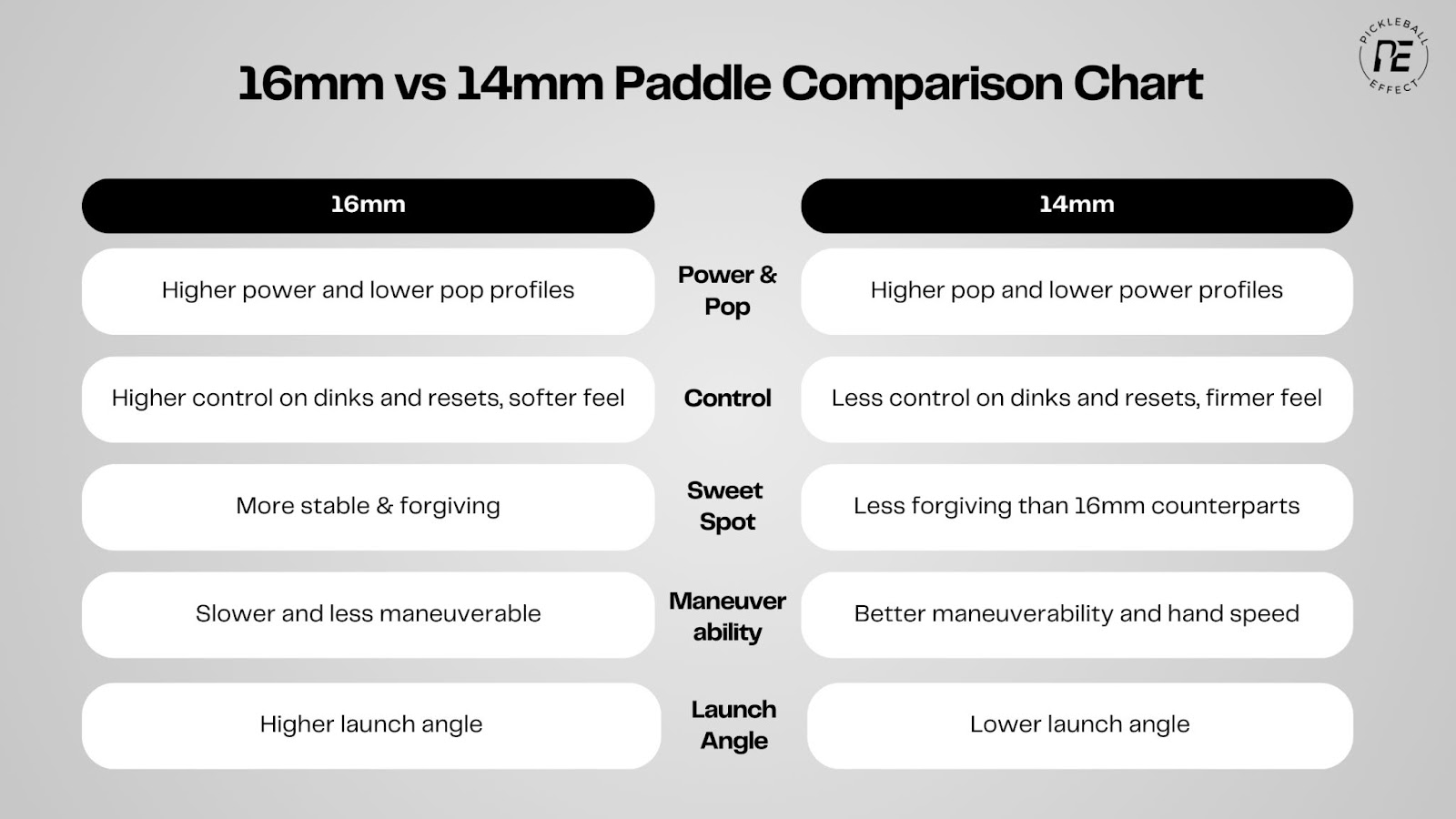
The 14 mm vs 16 mm pickleball paddle debate comes down to speed versus forgiveness. A 14 mm model usually gives more pop on a short swing. It feels crisp and fast at the net. A 16 mm model calms the ball, widens the sweet spot, and helps on touch shots.
Here is how it shows up on court:
- Ball speed: 14 mm tends to be faster off the face on compact swings.
- Control window: 16 mm helps you aim dinks, drops, and resets with less spray.
- Stability: 16 mm resists twisting better on off-center contact.
- Feel: 14 mm feels crisp; 16 mm feels plush.
- Noise: 16 mm is slightly quieter and lower pitched for most builds.
If you attack often and want jumpy put-aways, 14 mm can shine. If you win with patience, resets, and placement, 16 mm is a safer bet. Many players carry both and pick based on opponents or court speed.
Performance comparison: power, control, spin, forgiveness, stability
Power
- 14 mm: More pop on short, hands battles and counterpunches.
- 16 mm: Power is there but needs more swing or mass.
Control and touch
- 14 mm: Launch angle can vary more on off-center hits.
- 16 mm: Adds dwell time and tempers the ball for clean placement.
Spin
- Face texture, grit, and carbon layup drive spin far more than thickness.
- With the same face, 16 mm can raise spin consistency by keeping the ball on the face a touch longer.
Forgiveness and stability
- 16 mm paddles tend to have a wider effective sweet spot.
- They also dampen mishits and reduce twist on blocks.
Noise and vibe
- 16 mm often sounds deeper and feels softer.
- 14 mm rings a bit brighter and can feel more direct.
From my testing sessions, players who miss long on drops often settle once they switch to 16 mm. Players who struggle to finish at the net often perk up with 14 mm. The 14 mm vs 16 mm pickleball paddle choice should mirror your most common miss.
Who should choose 14 mm vs 16 mm pickleball paddle
Pick 14 mm if:
- You like fast hand battles and counters.
- You swing short and want the paddle to add speed.
- You play singles or drive first and often.
- You want extra pop without adding lead tape.
Pick 16 mm if:
- You reset a lot and live at the kitchen line.
- You value placement over blast speed.
- You struggle with balls flying long.
- You want more comfort for your wrist, elbow, or shoulder.
If you are on the fence, ask yourself this: Where do you lose points today? If the answer is pop and put-aways, go 14 mm. If the answer is control and consistency, go 16 mm. That simple frame helps most people nail the 14 mm vs 16 mm pickleball paddle choice fast.

Materials, cores, and build quality that change the feel
Not all 14 mm or 16 mm paddles are equal. The core and face matter as much as thickness.
Core types
- Polymer honeycomb: The standard. Thicker cores give more damping and a lower pitch.
- Thermoformed walls: Bonded edges boost stiffness and power for both 14 mm and 16 mm.
- Foam-injected edges: Increases twist resistance and sweet spot size.
- Hybrid cores: Mixed cell sizes to blend pop and control.
Face materials
- Raw carbon fiber: High spin, stable, and a longer dwell feel.
- Fiberglass: Lively, poppy feel with less dwell.
- Kevlar or hybrid weaves: Firmer feel with unique vibration patterns.
Build quality
- Consistent layup and strong bonding reduce dead spots.
- Good QC means your 14 mm vs 16 mm pickleball paddle choice will behave as expected.
From my test bench, a raw carbon 16 mm can feel livelier than an old fiberglass 14 mm. Build and weight tuning can flip the script. So always judge with your hands, not the sticker.

Sound, feel, and arm health
Many players choose 16 mm to calm sting and protect their arm. Thicker cores tend to reduce high-frequency buzz that can bother the elbow. This does not replace clean form, warm-ups, and smart volume. But it helps.
A 14 mm paddle can feel crisp and fast, but that sharper impact can bother some players with tennis elbow. A 16 mm paddle often feels plush and absorbs shock well. If you are recovering from arm pain, the safer first stop is 16 mm plus a softer ball.
Practical tweaks also help:
- Add a thicker grip to cut vibration.
- Add lead at 3 and 9 for twist stability.
- Use softer balls on cold days to reduce shock.

How to test 14 mm vs 16 mm pickleball paddle the right way
Use a short, focused plan. You will feel the real difference in 20 minutes.
Warm-up
- Dinks cross-court to feel dwell and aim.
- Third-shot drops to spot your long misses.
Control drills
- Reset from mid-court. Count how many land in the kitchen.
- Block drives at the net. Track how many fly long.
Power drills
- Counter battles at the kitchen. Note who wins hands.
- Deep drives from the baseline. Watch launch angle and depth control.
Spin checks
- Topspin roll from the transition zone.
- Slice dink control on low balls.
Decision rule
- If your errors are long and wide, the 16 mm fixes more.
- If you leave sitters on the table, the 14 mm wakes up your offense.
Do this same test twice on different days. Court speed, wind, and your body can change the result. The 14 mm vs 16 mm pickleball paddle choice should hold up across sessions, not just on one hot streak.

Mistakes to avoid when choosing thickness
Common pitfalls I see:
- Chasing only power. A poppy 14 mm that sprays balls loses matches.
- Ignoring weight. A well-weighted 16 mm can hit just as hard.
- Discounting form. If your drops are off, thickness is not a magic fix.
- Testing cold. Paddles feel firmer in cold weather; retest in normal temps.
- Overlooking noise rules. Some courts prefer quieter gear; 16 mm helps.
Keep your goals clear. The right paddle should reduce your worst misses and push your strength higher. Let the score, not the hype, make the call.
Tuning your paddle: weight, balance, and grip
You can fine-tune either thickness to fit your game.
Add weight
- Lead at 12 o’clock adds power and plow.
- Lead at 3 and 9 o’clock boosts stability and sweet spot.
- Keep swing weight in your comfort zone to protect your arm.
Balance and feel
- Head-heavy adds power but slows hands.
- Head-light speeds hands but can reduce put-away force.
Grip and comfort
- Build up the grip if you feel sting.
- A slightly tacky grip helps relax your hold and improves touch.
These small tweaks can close the gap between 14 mm vs 16 mm pickleball paddle options. Many players find their sweet setup with a 16 mm base plus light lead for power.
Real-world examples from the court
I coach a 4.0 player who drove hard but sprayed his drops long. He moved from a 14 mm to a 16 mm with a raw carbon face. His resets tightened up on day one. We added a touch of lead at 3 and 9, and his counters stayed deep without flying long.
Another player, a 3.5 doubles partner, struggled to finish at the net. She swapped from 16 mm to 14 mm and felt an instant jump in pop. Her hands won more points in tight exchanges. We kept the paddle light to protect her shoulder, and her win rate climbed.
These are common stories. The 14 mm vs 16 mm pickleball paddle decision often mirrors your most frequent rally type. If your game is fast and punchy, start with 14 mm. If it is patient and precise, start with 16 mm.
Price, durability, and rules
Price
- Thickness alone does not set price. Face tech and build process drive cost.
- Premium raw carbon and thermoformed builds raise the price for both 14 mm and 16 mm.
Durability
- Thicker cores can resist soft spots longer, but QC matters more.
- Edge bonding and foam injections help both thicknesses age well.
Rules
- Check USA Pickleball approval for your model before league play.
- Some venues care about sound; thicker paddles often test quieter.
When comparing 14 mm vs 16 mm pickleball paddle options, always check warranty terms and brand support. A solid warranty beats a tiny performance edge.
Quick buyer’s guide: making the final call
Ask these questions:
- Do I need more pop or more control today?
- Where are my match-losing errors?
- What weight and balance feel good in my hand?
Try this simple rule:
- Offensive minded, short swing, fast hands: start 14 mm.
- Control minded, reset heavy, arm sensitive: start 16 mm.
If you still cannot decide, pick the model that fixes your biggest miss in testing. The 14 mm vs 16 mm pickleball paddle choice is not a one-time verdict. As your game evolves, your paddle can too.
Frequently Asked Questions of 14 mm vs 16 mm pickleball paddle
Is a 14 mm paddle always more powerful than a 16 mm?
Not always. A 16 mm with higher swing weight or stiffer layup can hit harder. But in same-build comparisons, 14 mm usually feels poppier on short swings.
Which thickness is better for tennis elbow?
Most players find 16 mm gentler on the arm due to extra damping. Pair it with a cushioned grip and proper warm-up.
Does thickness change spin a lot?
Spin comes mostly from the face texture and layup. Thickness can help spin consistency by adding dwell time, but it is a secondary factor.
What thickness should beginners choose?
Many beginners do well with 16 mm because it adds control and forgiveness. It helps keep balls in play while you build touch.
Can lead tape make my 16 mm feel as powerful as a 14 mm?
It can close the gap by adding plow and stability. You may still feel a softer impact, but power can match or exceed with the right weight.
Is 14 mm better for singles?
Often yes, due to easier depth and put-away pop. But if you rely on precision and long rallies, a stable 16 mm can also work well.
Will a 16 mm paddle be too slow at the net?
Not if the swing weight stays moderate. Many 16 mm paddles are quick in hand and still offer strong blocks and counters.
Conclusion
Thickness is a simple spec with a big on-court effect. Choose 14 mm for fast pop and quick finishes. Choose 16 mm for control, comfort, and a bigger sweet spot. Test both with the same drill plan, track results, and let your match errors guide you.
Act now. Book a demo day, run the drills above, and write down what changed. Your ideal 14 mm vs 16 mm pickleball paddle is the one that cuts errors and boosts your strengths. If this helped, share it with a partner or drop a question for a custom recommendation.